


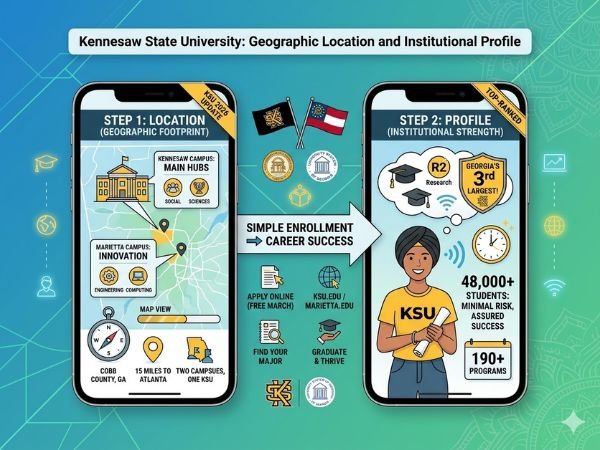

The proliferation of collegiate branding across various media often introduces regional institutions to a national audience, occasionally prompting geographical confusion. A notable example is the prominent visual presence of a stylized owl mascot across the Southern United States, leading many observers to ask, fundamentally, where is Kennesaw State from? Despite its increasing prominence in academic and athletic circles, the institution’s geographical coordinates remain obscure to individuals residing outside its immediate vicinity. This lack of immediate recognition highlights the necessity for a comprehensive overview of the university’s location and structural evolution.
Navigating Geographic Ambiguity
The absence of a globally recognized geographic identifier in the university’s nomenclature frequently leads to spatial ambiguity among the general public and sports enthusiasts. When a collegiate athletic team achieves national visibility without the benefit of a prominent state or metropolitan namesake, questions invariably arise regarding its origin. Specifically, historical inquiries regarding where is Kennesaw State College frequently occur due to its transformation over the decades from a localized commuter college to a major university. This ambiguity underscores a broader systemic challenge wherein regional institutions struggle to establish immediate geographic context in the minds of a national audience.
Addressing Navigational Challenges
This spatial ambiguity is further compounded by navigational challenges, as prospective students and academic visitors may inadvertently encounter logistical inefficiencies. A standard digital inquiry to determine where is Kennesaw State University often yields multiple municipal results, generating potential confusion. The prospect of navigating toward an incorrect destination underscores the necessity for precise geographical clarification. Clear, authoritative directions are essential to mitigate the logistical friction experienced by prospective students, parents, and visiting academics attempting to access the institution.
also read : Role of AI and ML in Education
The Dual-Campus Infrastructure
To definitively clarify its geographic footprint and answer the primary question of where is Kennesaw State located, it must be stated that the institution resides in the state of Georgia, situated approximately thirty minutes north of the Atlanta metropolitan area. A defining characteristic of the university’s modern structural framework is its dual-campus system. The primary campus is located in the municipality of Kennesaw, serving as the central administrative and academic hub. Conversely, the secondary campus is located in the adjacent city of Marietta. This dual-campus configuration is the direct result of a strategic consolidation orchestrated by the University System of Georgia, which formally merged Kennesaw State University with the former Southern Polytechnic State University.
Academic Reputation and Institutional Focus
A thorough evaluation of the institution invariably leads to the inquiry: What is Kennesaw State University known for? Currently, the institution transcends its historical status as a minor regional college, having expanded into a formidable educational powerhouse boasting an enrollment exceeding 43,000 students. This significant demographic expansion designates it as one of the largest universities within the state of Georgia. Academically, the university is particularly renowned for its robust programs within the College of Business, as well as its rigorous curricula in engineering, nursing, and architecture. The institutional pedagogy heavily emphasizes practical skill acquisition, technological proficiency, and career readiness.
The Marietta Campus: Specialization in Technology and Engineering
The integration of the Marietta campus significantly enhanced the university’s technical infrastructure. Stemming from its polytechnic origins, the Marietta location maintains specialized facilities tailored for advanced technical disciplines. It offers sophisticated laboratories and immersive learning environments for programs such as cybersecurity, software engineering, and architecture. This infrastructure fosters an experiential pedagogical model, ensuring that students engaged in these disciplines benefit from hands-on application and technological innovation rather than relying solely on theoretical instruction.
also read : – Requirements for North Carolina Contractor Continuing Education
Athletic Programming and Infrastructure
The university’s athletic profile has also experienced substantial expansion, most notably with the establishment of its collegiate football program in 2015. For those researching athletic facilities to determine where is Kennesaw State football hosted, the primary venue is the Fifth Third Stadium, situated in close proximity to the main campus in Kennesaw. The rapid ascension and competitive success of the football program have cultivated a highly dedicated fan base, officially recognized as “Owl Nation.” This athletic success has significantly contributed to the cultivation of a vibrant, traditional collegiate atmosphere.
The Significance of Collegiate Traditions
The institutional culture is further augmented by established pre-game traditions, particularly the practice of tailgating. These communal events, held in the stadium perimeters prior to athletic contests, foster a profound sense of community, civic pride, and collegiate solidarity among the student body, alumni networks, and local residents. Such traditions are instrumental in creating an immersive university environment that extends beyond purely academic pursuits.
The Evolution of Campus Life
A historical analysis of the institution reveals a dramatic transformation over recent decades. Previously characterized by a transient commuter demographic, the university has systematically developed into a comprehensive residential destination. Modern campus amenities, including extensive residential halls and advanced culinary centers, reflect this transition. The provision of diverse, high-quality dining options and enhanced residential facilities illustrates a concerted effort to cultivate a holistic and immersive student experience.
Leveraging Metropolitan Proximity
The geographical proximity to the Atlanta metropolitan area provides Kennesaw State University students with a distinct competitive advantage. This strategic location facilitates unparalleled access to highly sought-after internships, cooperative education programs, and employment opportunities with major multinational corporations headquartered in the region. Consequently, students are afforded the dual benefits of a traditional suburban campus environment and direct integration into a major global economic hub, thereby optimizing post-graduate employment prospects.
Optimizing Intercampus Mobility
To address the logistical complexities inherent in a dual-campus structure, the university administration has implemented an efficient intercampus transit system, officially designated as the Big Owl Bus (BOB). This complimentary shuttle service operates extensively along the Interstate 75 corridor, optimizing student mobility between the Kennesaw and Marietta locations. By providing reliable transportation, the university actively mitigates the widespread infrastructural challenges associated with collegiate parking and vehicle management.
Regional Context and Recreational Opportunities
The surrounding municipality of Kennesaw offers a rich historical context and a favorable quality of life, complementing the academic environment. Furthermore, the proximity of significant natural landmarks, such as the Kennesaw Mountain National Battlefield Park, provides the academic community with valuable recreational opportunities. Access to such environments is widely recognized as highly conducive to mental well-being and stress mitigation for students engaged in rigorous academic programs.
also read : – APPS FOR PERSONAL EXPENSE TRACKING
Economic Viability and Enrollment Growth
The sustained and significant enrollment growth at Kennesaw State University can be largely attributed to its compelling economic value proposition. Amidst a national landscape characterized by escalating higher education costs, KSU, as a public institution, offers highly competitive tuition rates. This financial accessibility provides a broad demographic with the opportunity to secure a respected academic credential without incurring prohibitive long-term debt, representing a prudent financial calculation for prospective students and their families.
Frequently Asked Questions (FAQ)
In which municipality is the primary institution located?
The administrative center and primary campus are located in Kennesaw, Georgia, with a secondary, specialized campus situated in the neighboring city of Marietta. Both locations are positioned within the broader Atlanta metropolitan statistical area.
What is the status of the university’s football program?
The institution maintains a highly competitive football program that has achieved significant success since its inception, contributing heavily to the university’s national athletic profile.
Is the institution classified as public or private?
Kennesaw State University is a public university operating under the jurisdiction of the University System of Georgia.
What is the official university mascot?
The official mascot is the Owl, frequently represented by the character “Scrappy the Owl,” which serves as the primary visual identifier for the institution’s athletic and academic branding.
What is the current scale of student enrollment?
The institution is classified as a large-scale university, currently accommodating an enrollment that exceeds 43,000 students.
Are incoming freshmen required to reside on campus?
Generally, first-year students are subject to a residential requirement, an administrative policy designed to facilitate social integration and acclimatization to the collegiate environment.
Conclusion
In summation, Kennesaw State University has strategically and systematically expanded from a localized regional college into a major educational powerhouse situated strategically within the Northern Atlanta corridor. Its robust academic programming, combined with significant athletic development and infrastructural expansion, solidifies its position as a highly attractive and economically viable option within the landscape of higher education in the Southern United States.