




Talsari Sea Beach, sometimes spelled Talasari, sits near the Odisha–West Bengal border.
It is about 8–16 km from Digha, yet it feels very different from the busy beaches there.
The beach sits near the meeting point of the Subarnarekha River and the Bay of Bengal. Tall palms, mangrove growth, calm estuary water, and thousands of red ghost crabs give the coast its own character.
The biggest attraction isn’t a long row of shops.
It is the natural setting.
At low tide, broad sandbars appear. Red ghost crabs move across the wet sand. Local fishing boats rest near the estuary, and the coast becomes much quieter than Digha.
Talsari Sea Beach at a Glance
| Detail | Information |
|---|---|
| Distance from Digha | 8–16 km |
| Digha to Talsari drive | About 25–30 minutes |
| Operating hours | 5:00 AM–8:00 PM |
| Best season | October–March |
| Famous for | Red ghost crabs, estuary, low-tide walks |
| Nearest railway stations | Digha and Jaleswar |
These figures come from the supplied travel source.
Why Talsari Beach Is Different
Talsari feels quieter as soon as you leave the busier Digha area.
The Subarnarekha flows beside the coast, creating a broad estuary with changing water levels.
At low tide, the exposed sand becomes a huge open walking area.
The beach is known for red ghost crabs, locally noticeable across the wet sand. Their scientific name is Ocypode macrocera. The source links their study with the Zoological Survey of India.
This is a good place for:
- Nature photography
- Crab watching
- Sunrise and sunset views
- Low-tide walks
- Boat rides
- Short trips from Digha
Red Ghost Crabs at Talsari

The red ghost crab is one of the main reasons travelers visit Talsari.
During low tide, the wet sand can appear covered with moving red dots.
The crabs move very quickly and can disappear into their burrows after sensing footsteps. They flatten close to the sand and use their speed to escape birds and other predators.
How to Photograph Them
Don’t run after the crabs.
Stop at a distance and stay still for a few minutes.
The crabs are sensitive to ground movement. Once the beach becomes quiet again, they start coming out.
Protect the Crab Habitat
The supplied source says crab numbers are falling in some areas, with pollution and vehicles on soft sand listed as concerns.
Keep cars and bikes in the parking area.
Walk on firm paths and avoid driving across crab habitat.
The Subarnarekha Estuary and Tidal Beauty
The estuary is the most unusual part of a Talsari visit.
The river and sea meet here, creating a coastal area that changes through the day.
The river crossing can look completely different at high and low tide.
During High Tide
The riverbed can fill with around 4–5 feet of water.
Local boatmen can take visitors across in a small boat.
The source lists a crossing cost of around ₹20–₹50.
During Low Tide
The water moves far away from the sandbar.
A broad, firm stretch of exposed riverbed appears.
The source says the walk can take around 10–15 minutes and may reveal fishing boats resting on the exposed sand.
Talsari Tide Timings: What You Need to Know
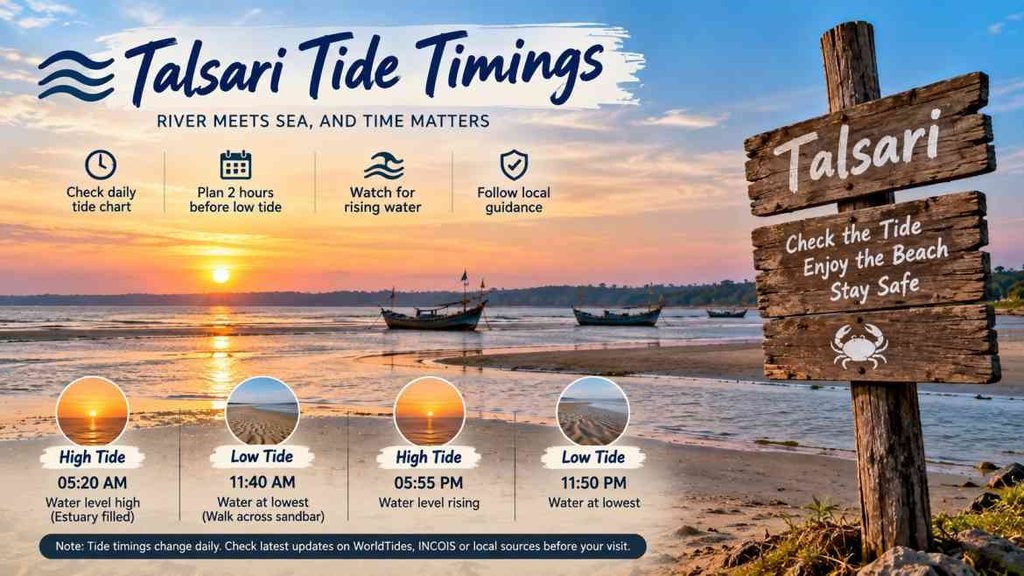
Tide timing matters more here than a fixed travel schedule.
The estuary can fill quickly as the tide returns.
A visitor who walks too far across the exposed sand can get caught by rising water.
The source advises reaching the beach around two hours before the lowest tide. This gives you time to cross the sandbar, explore, and begin the return before the water rises.
Watch the local fishermen.
When they start moving their boats toward higher ground, treat it as a clear warning that the water is returning.
A Useful Local Tide Signal
The source quotes local boatman Bikash Majhi, who says a sudden drop in sea wind and birds moving back toward land can signal a quick change in tide conditions.
Don’t rely on this sign alone.
Check a current tide forecast before your walk.
The source lists services such as WorldTides, INCOIS, Windy, and eTide HDF for tide and coastal conditions.
Full Moon and New Moon Tides
Moon phases can change tidal strength.
The supplied guide says Purnima and Amavasya can bring stronger spring tides, exposing larger sandbars at low water.
The return tide can come back faster and deeper too.
So these dates can be great for photography and wide sandbar views, but they need tighter tide planning.
Safe vs Dangerous Tide Periods
| Tide Phase | What to Do | Risk |
|---|---|---|
| 2 hours before low tide | Start the crossing | Low |
| Exact low tide | Explore and take photos | Low |
| 1 hour after low tide | Begin return | Medium |
| High tide | Don’t walk across | High |
How to Reach Talsari Sea Beach
Talsari sits close to the Odisha–West Bengal border, so Digha is the easiest starting point for many visitors.
By Train
Digha Railway Station is around 10 km from Talsari.
Jaleswar Railway Station in Odisha is around 36 km away.
The source recommends arriving during daylight since getting a local ride later in the evening can be harder.
Digha to Talsari by Taxi or Auto
The ride takes around 25–30 minutes.
The route crosses from West Bengal into Odisha.
The source lists private taxi fares around ₹300–₹500.
Shared autos are much cheaper, with a listed fare of around ₹50 per seat.
A small extra charge may apply for interstate travel.
By Road
The source lists:
- Kolkata to Talsari: about 171 km
- Bhubaneswar to Talsari: about 290 km
- Balasore to Talsari: about 90 km
From Balasore, the source gives a travel time of around two hours. Parking is available close to the beach.
By Air
The source lists Kolkata Airport at around 190 km.
A direct airport taxi can cost much more than needed for this trip.
A train to Digha, followed by a short local ride to Talsari, can reduce the cost.
Where to Stay Near Talsari
Talsari has simple accommodation close to the Odisha side.
For larger hotels and resort facilities, Digha offers more options.
Budget Stays
The source lists rooms around ₹800–₹1,500.
Hotel Dolphin and Barsha Resorts are mentioned as budget options near the New Digha side.
Mid-Range Stays
The source lists a range of around ₹1,500–₹3,500.
It mentions OTDC Panthasala for sea views and Hotel Shree Inn Talasari for families.
Premium Stays
For pool and resort facilities, the source points to properties in Digha such as Zone by The Park Digha and Antique Regency.
These aren’t on Talsari itself, but they remain within a short drive.
Things to Do at Talsari Sea Beach
1. Watch the Red Ghost Crabs
Visit during low tide and walk near the wet sand.
Stand still and let the crabs return.
Morning light is useful for photos.
2. Walk Across the Sandbar

Low tide exposes the Subarnarekha riverbed.
A short walk can take you toward the main beach.
Keep the return time in mind. Never start a long walk without checking the tide.
3. Take a Mangrove Boat Ride
Bichitrapur Mangrove Sanctuary is around 10 km away.
A private boat for 6–8 people costs around ₹1,200–₹1,400, according to the source.
The route can take you toward Subarna Island, where horseshoe crabs are a major wildlife attraction.
4. Look for Horseshoe Crabs

The nearby Subarna Island area is linked with Indian horseshoe crabs.
The source describes these animals as living fossils and notes their relation to spiders and scorpions rather than true crabs.
Their blue blood has scientific value in medical testing.
5. Sunrise and Sunset Photography
The flat wet sand reflects the sky and sunlight.
Early morning is especially useful for crab photography since the beach is quieter.
6. Visit Chandaneswar Temple
Chandaneswar Temple is around 3 km away.
The source describes it as an ancient Shiva temple linked with the 13-day Chaitra Mela.
Bhusandeswar Temple is around 18 km away and is another option for temple visits.
7. Browse Local Markets
Near Chandaneswar Temple, small shops sell shell crafts and grass mats.
Buying from local sellers can support village workers.
A Simple 1-Day Digha to Talsari Plan
For visitors staying in Digha, a day trip works well.
8:00 AM — Leave Digha
Take a shared auto or hire a private ride.
8:30 AM — Reach the Estuary
Check the tide before crossing.
9:00 AM — Crab Watching
Explore the wet sand and look for red ghost crabs.
12:30 PM — Seafood Lunch
Try fresh local fish at a small beach shack.
2:00 PM — Return
Start heading back before rising water becomes a problem.
The exact timing should change with the tide on your travel date.
Local Boat Hire Point
The supplied source gives this GPS location for the Subarnarekha crossing area:
21°33′18″N 87°23′31″E
It describes this point as the area where local fishermen offer short estuary crossings during suitable water conditions.
Check the tide before heading to the crossing.
Nearby Places Around Talsari
Udaipur Beach
Udaipur is around 3 km away.
The source lists a local auto fare around ₹100 and coconut water around ₹40.
Bichitrapur Mangrove Sanctuary
The sanctuary is around 10 km away.
The source recommends reaching before 9:00 AM for calmer water and clear reflections among the mangroves.
Khirachora Gopinath Temple
The temple at Remuna is around 90 km from Talsari.
The source lists free entry and mentions the local Khira milk sweet.
Talsari Food and Seafood Costs
There are no large restaurants on the beach.
The local seafood is the main draw.
Fresh fish can be bought from local fishermen and cooked at small beach shacks.
The source mentions Pomfret, prawns, Hilsa, Bhetki, and Parshe as common choices.
Morning Fish Auction
For the freshest local catch, the source points to the morning Khuti fish auction.
The suggested time is around 6:30 AM, before larger buyers take much of the catch.
Local vs City Fish Prices
| Fish | Local Auction | City Price |
|---|---|---|
| Pomfret | ₹300–₹400/kg | ₹700–₹800/kg |
| Hilsa | ₹600–₹800/kg | ₹1,200–₹1,500/kg |
| Bhetki | ₹350–₹450/kg | ₹600–₹700/kg |
| Parshe | ₹200–₹250/kg | ₹400–₹500/kg |
| Local Prawns | ₹250–₹350/kg | ₹500–₹600/kg |
These figures are from the supplied source.
Talsari Trip Budget
The source gives these estimated local costs:
| Expense | Estimated Cost |
|---|---|
| Shared auto | ₹50–₹100 per seat |
| Estuary boat | ₹20–₹50 per person |
| Seafood meal | ₹200–₹400 per person |
| Mangrove boat | ₹1,200 for up to 6 people |
A local fish curry such as Macher Jhol can make a simple lunch complete.
Talsari Beach Safety Tips
The estuary is the part that needs the most care.
Watch the Tide
Ask your hotel or local boatman about the high-tide period.
Never start a long sandbar walk without knowing the return window.
Protect Your Feet
The riverbed can contain sharp shells and hidden rocks.
Wear thick sandals or secure water footwear.
Carry Water and Sun Protection
There is little shade on the flat sand.
Carry drinking water, sunscreen, and a hat.
Don’t Chase the Crabs
Red ghost crabs are easily disturbed.
Watch from a distance and let them move naturally.
Talsari Weather by Season
October to March
This is the main season listed by the source.
Temperatures are given around 15°C–25°C, making beach walks comfortable.
April to June
Summer can cross 35°C.
Early morning and late evening are more comfortable.
July to September
Monsoon brings rough seas and heavy river flow.
The source warns against sandbar walks and boat trips during unsafe conditions.
Ecotourism at Talsari
Talsari is a fragile coastal habitat.
The supplied guide highlights vehicle damage to soft sand and red ghost crab habitat.
Keep vehicles in parking areas.
Don’t drive onto the beach.
Carry plastic waste back to your hotel.
Local boatmen are another part of the coastal economy. Booking directly can send more of the money to local fishing families.
Talsari History and Culture
The source connects the name Talsari with palm trees.
“Tala” means palm and “Sari” means row.
Long lines of palms and casuarina trees fit that description well.
Nearby Chandaneswar Temple is described as more than a thousand years old. During the Chaitra Mela, large crowds gather for religious celebrations.
FAQs
Why Is Talsari Sea Beach Famous?
Talsari is known for red ghost crabs, the Subarnarekha estuary, and broad sandbars visible during low tide.
How Far Is Talsari From Digha?
The source gives a distance of around 8–16 km.
The drive takes roughly 25–30 minutes by the Udaipur–Talsari marine road.What Is the Best Time to Visit Talsari?
The source recommends October to March, when temperatures stay around 15°C–25°C.
How Do I Reach Talsari From Kolkata?
Take a train from Howrah or Shalimar to Digha.
From Digha, continue by taxi or shared auto toward Talsari and cross into Odisha.Can I Easily See the Red Ghost Crabs?
Yes, but they move very fast.
Stand still and give them time to come out of their burrows.Where Can I Stay Near Talsari?
The source mentions simple government accommodation on the Odisha side and larger resorts around Digha.
Is the Beach Safe to Walk?
Low-tide walking can be possible when local conditions are suitable.
The danger starts when the tide turns and water returns across the sandbar.
Watch local fishermen and begin your return early.
Final Words
Talsari Sea Beach offers a quieter side of the Odisha coast.
The red ghost crabs are the headline attraction, but the real charm comes from the Subarnarekha estuary, changing sandbars, fishing boats, mangroves, and low-tide scenery.
A good Talsari trip starts with the tide chart.
Reach early. Keep your feet protected. Carry water. Leave vehicles off the soft sand.
For a Digha trip, Talsari works well as a half-day or full-day outing, especially between October and March.