


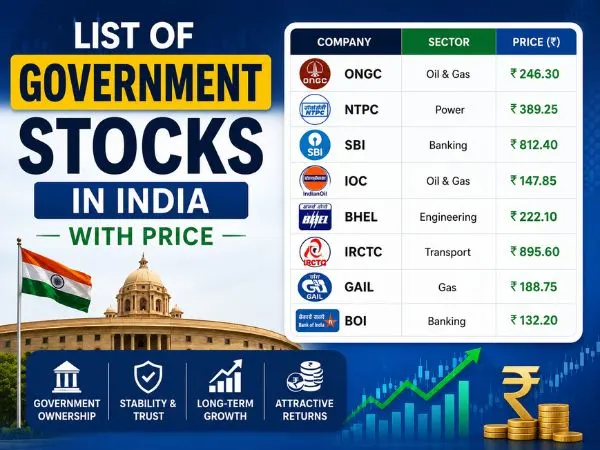

Investing in government-backed companies is one of the most popular strategies for Indian investors seeking stability, massive scale, and reliable dividend income. Officially known as Public Sector Undertakings (PSUs), these are companies where the Government of India holds a majority stake (51% or more).
Whether you are looking for high-dividend energy giants, booming defence contractors, or reliable public sector banks, having a clear view of the market is essential. Below is a comprehensive list of government stocks in India with price estimates, categorized by sector to help you structure your portfolio.
(Note: Stock prices are highly dynamic. The prices listed below reflect approximate trading ranges as of mid-2026 and are meant for reference purposes. Always check real-time prices before investing.)
1. Public Sector Banks (PSBs)
Public Sector Banks form the backbone of the Indian financial system. After years of cleaning up non-performing assets (NPAs), many of these banks are now highly profitable and offer strong long-term value.
| Company Name | Stock Ticker | Approx. Share Price (₹) |
| State Bank of India | SBIN | 1,034.00 |
| Bank of Baroda | BANKBARODA | 279.00 |
| Union Bank of India | UNIONBANK | 174.00 |
| Canara Bank | CANBK | 130.00 |
| Punjab National Bank | PNB | 107.00 |
| Indian Bank | INDIANB | 843.00 |
| Bank of India | BANKINDIA | 144.00 |
| Bank of Maharashtra | MAHABANK | 87.00 |
| Indian Overseas Bank | IOB | 34.00 |
| Central Bank of India | CENTRALBK | 32.00 |
2. Energy, Oil, and Power PSUs
The energy sector contains some of the largest “Maharatna” companies in India. These stocks are famous for their near-monopoly market positions, massive cash reserves, and exceptionally high dividend yields.
| Company Name | Stock Ticker | Approx. Share Price (₹) |
| Coal India Ltd | COALINDIA | 441.00 |
| NTPC Ltd | NTPC | 364.00 |
| Oil and Natural Gas Corp | ONGC | 244.00 |
| Power Grid Corp of India | POWERGRID | 290.00 |
| Bharat Petroleum Corp | BPCL | 308.00 |
| Indian Oil Corp | IOC | 143.00 |
| Hindustan Petroleum Corp | HPCL | 396.00 |
| GAIL (India) Ltd | GAIL | 174.00 |
| Power Finance Corp | PFC | 430.00 |
| NHPC Ltd | NHPC | 77.00 |
3. Defence and Aerospace PSUs
With the government’s aggressive push for “Make in India” and defence indigenization, PSU defence stocks have seen explosive growth. These companies boast multi-year, multi-billion-dollar order books.
| Company Name | Stock Ticker | Approx. Share Price (₹) |
| Hindustan Aeronautics Ltd | HAL | 4,499.00 |
| Bharat Electronics Ltd | BEL | 419.00 |
| Mazagon Dock Shipbuilders | MAZDOCK | 2,504.00 |
| Cochin Shipyard Ltd | COCHINSHIP | 1,485.00 |
| Bharat Dynamics Ltd | BDL | 1,390.00 |
| Bharat Heavy Electricals | BHEL | 399.00 |
4. Railway and Infrastructure PSUs
The rapid modernization of Indian Railways and massive capital expenditure allocations in recent union budgets have turned railway PSUs into multi-bagger stocks over the last few years.
| Company Name | Stock Ticker | Approx. Share Price (₹) |
| IRCTC Ltd | IRCTC | 518.00 |
| Rail Vikas Nigam Ltd | RVNL | 240.00 |
| IRCON International Ltd | IRCON | 136.00 |
| Indian Railway Finance Corp | IRFC | 98.00 |
| RITES Ltd | RITES | 209.00 |
| Container Corp of India | CONCOR | 478.00 |
Why Invest in Government Stocks?
Before buying any of the stocks on this list, it helps to understand why investors actively seek out government-backed companies:
- High Dividend Yields: Because the government is the majority shareholder and needs revenue to fund the national fiscal deficit, cash-rich PSUs (like Coal India, ONGC, and BPCL) frequently declare massive dividends.
- Sovereign Backing: While these companies can still experience stock price volatility, the underlying businesses carry practically zero risk of bankruptcy because they are backed by the central government.
- Monopoly Advantages: Many PSUs operate in sectors with exceptionally high barriers to entry. For example, IRCTC has a pure monopoly on railway ticketing, and HAL is the sole supplier of fighter jets to the Indian Air Force.
also read : – Investing For Beginners
Want to know how to pick the best PSU stocks?
Evaluating government stocks (PSUs) requires a slightly different lens than private companies. Why? Because the majority shareholder—the government—sometimes prioritizes national interests (like keeping fuel prices low) or fiscal deficit targets over pure shareholder profit.
Here are the specific financial metrics and “hidden” factors you need to check before adding a PSU to your long-term portfolio:
1. Dividend Yield (The Cash Generator)
Because the government relies on PSUs to fund the national budget, these companies are mandated to pay out a significant portion of their profits as dividends.
- What to look for: A consistent dividend yield of 4% to 6% or higher.
- The Trap: Don’t buy a stock just for the yield. If a stock’s price drops by 50%, its dividend yield artificially doubles. Ensure the company is actually generating free cash flow to sustain those payouts.
2. Price-to-Book (P/B) Ratio
PSUs are often massive, asset-heavy companies (think oil refineries, power plants, and banks). The P/B ratio tells you if you are paying a premium for those assets.
- What to look for: Traditionally, a P/B of under 1.5 was considered good for a PSU bank or utility, meaning you were buying the company’s assets at a discount.
- The Exception: High-growth PSUs (like defence and railway stocks) are currently trading at much higher P/B ratios (often 4 to 8) because investors are paying for future growth, not just current assets.
3. Order Book-to-Revenue Ratio (Crucial for Defence & Rail)
For companies like HAL, RVNL, or Mazagon Dock, past revenue doesn’t matter as much as future contracts.
- What to look for: Divide their total unexecuted Order Book by their Annual Revenue. If a company makes ₹10,000 crore a year but has an order book of ₹40,000 crore, that gives them a ratio of 4.0x (four years of guaranteed revenue visibility). The higher this number, the safer your investment.
4. Return on Capital Employed (ROCE)
Historically, PSUs were criticized for being inefficient with capital. ROCE tells you how effectively the management is using its money to generate profits.
- What to look for: Look for a consistently improving ROCE of 15% or higher. If a power or mining PSU has a low ROCE (under 8%), it means they are destroying shareholder value despite being massive in size.
5. The “Hidden” Metric: Government Holding (OFS Overhang)
By SEBI law, the promoters (the government) cannot own more than 75% of a listed company.
- What to look for: Check the Promoter Holding. If the government owns 80% or 86% of the company, they will eventually have to sell shares to the public to bring it down to 75%. This is done through an Offer For Sale (OFS), which is usually priced at a discount and temporarily drives the stock price down. If you buy right before an OFS, you might face immediate short-term losses.
Key takeaway: A great PSU investment combines a safe dividend yield, an expanding order book, and a management team that is actively improving its profit margins (ROCE).