


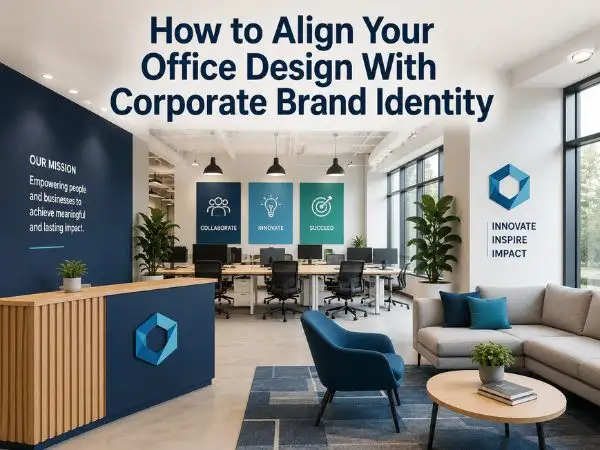

Your brand identity exists in logos, websites, marketing materials, and customer interactions. But it should also exist in your physical workspace. An office that connects meaningfully to your brand reinforces who you are, while one that contradicts your brand creates confusion about your company’s actual identity.
This matters whether you’re a law firm in the CBD, a tech startup in one-north, or a creative agency in Kampong Glam. Your space makes statements about your values, your market position, and how you see yourselves. You can either control those statements deliberately or let them happen by default.
Most businesses don’t think about brand alignment when planning office renovations. They focus on functional requirements – how many desks, how many meeting rooms, what facilities they need. The space ends up functional but generic, looking like it could belong to any company in any industry.
That’s a missed opportunity. Your office is one of the most substantial brand expressions you’ll create.
Translating Brand Guidelines Into Physical Space
Brand guidelines typically specify colors, typography, logo usage, and maybe tone of voice. But they rarely tell you how to translate those elements into three-dimensional space, which means someone needs to interpret the guidelines and apply them to interior design decisions.
Start with your brand colors. If your brand uses specific colors consistently, those colors should appear in your office – but not necessarily everywhere or at full intensity. Brand colors that work well in print or digital media can be overwhelming on walls or large surfaces.
Better to use brand colors as accents – in feature walls, furniture, artwork, or signage – while keeping the majority of the space in neutral tones that people can comfortably occupy for hours daily.
Typography from your brand system can inform signage and wayfinding design. If your brand uses a particular typeface consistently, using it on interior signs creates visual connection to your broader identity.
Visual language matters too. If your brand is geometric and minimalist, that should inform furniture choices, lighting design, and how space is organized. If your brand is organic and approachable, different furniture styles and spatial arrangements communicate that better.
Understanding What Your Brand Actually Represents
Before you can align your office with your brand, you need clarity about what your brand actually stands for. What are your core values? What differentiates you from competitors? How do you want to be perceived?
If your brand is about innovation and forward-thinking, your office should feel current, possibly incorporate smart technology, and avoid anything that reads as traditional or conservative. If your brand emphasizes heritage and reliability, your space can use materials and details that create a sense of establishment and permanence.
Service-oriented brands that emphasize client relationships benefit from offices that feel welcoming and comfortable rather than intimidating or overly corporate. Your reception area, meeting rooms, and how you create paths through your space all contribute to whether clients feel you’re accessible.
Brands positioning themselves as premium or exclusive should have office environments that support that positioning through material quality, finish details, and spatial design. You can’t claim to be a premium service while operating from a space that looks cheap or poorly executed.
Material and Finish Choices That Communicate Brand Values
Materials carry connotations whether you intend them to or not. Wood suggests warmth, nature, or tradition depending on how it’s used. Metal and glass suggest precision, technology, or modernity. Fabric and soft materials suggest comfort and approachability.
Choose materials that align with your brand character. A tech company might use exposed concrete, steel, and glass to communicate innovation and technical sophistication. A wellness brand might use natural wood, plants, and soft textiles to communicate health and balance. A professional services firm might use refined materials like marble, dark wood, and leather to communicate establishment and expertise.
Finish quality matters as much as material choice. The same material executed poorly sends different messages than the same material executed well. If your brand is about quality and attention to detail, your office finishes need to demonstrate that.
Work with a commercial interior designer like Design Bureau and you can select materials and finishes that support your brand narrative while also meeting your budget constraints.
Spatial Planning That Reflects How You Work
Brand alignment isn’t just about aesthetics – it’s about whether your space supports the way your organization actually operates. An advertising agency whose brand emphasizes collaboration but whose office is mostly closed spaces sends mixed messages.
If your brand values include collaboration and openness, your space planning should enable that through open layouts, shared spaces, and informal interaction zones. If your brand emphasizes expertise and specialization, having dedicated space for focused work and private client discussions supports that.
Think about how clients experience your space too. The journey from entering your office to reaching a meeting room communicates things about your organization. Do they pass through a busy open workspace where they see your team collaborating? Do they move through quiet corridors where the work happens behind closed doors? Both can be appropriate, but they communicate different things.
Meeting Rooms and Client-Facing Spaces
Client-facing spaces carry outsized importance for brand expression because they’re where people outside your organization form impressions. Your reception area, primary meeting rooms, and any spaces where clients spend time should connect clearly to your brand.
This doesn’t mean turning these spaces into marketing installations. It means ensuring they communicate your values and position through design choices. A creative agency might have meeting spaces that feel inspiring and slightly unexpected. A law firm might have meeting rooms that feel serious and confidential.
Meeting room design affects how clients perceive the conversations that happen there. A room with a large formal table creates different dynamics than a room with lounge-style seating. Neither is universally better, but they’re appropriate for different brands and different types of interactions.
Consider naming meeting rooms in ways that connect to your brand story. If your company has historical roots in specific Singapore locations, naming rooms after those places reinforces your heritage. If your work involves international markets, naming rooms after cities where you operate creates connection to that scope.
Artwork and Graphics as Brand Expression
Artwork throughout your office is an opportunity to reinforce brand narrative without being explicitly promotional. Custom graphics, photography, or commissioned artwork can tell your company’s story, illustrate your values, or simply create visual interest that aligns with your aesthetic.
Many Singapore businesses use local artists or photographers, which can connect your brand to the local community and arts scene. This works particularly well if your brand values include supporting local talent or being embedded in Singapore’s cultural context.
Graphics can also explain what you do in ways that pure decoration doesn’t. An architecture firm might display drawings or models of significant projects. A logistics company might use maps or transportation imagery.
Avoid treating your office walls like marketing brochures. But thoughtful graphic content that adds interest while supporting your narrative strengthens brand presence.
Brand Expression Through Furniture and Objects
Furniture choices contribute to brand perception more than most companies realize. The difference between Herman Miller task chairs and no-name budget seating sends signals about how you value your team. The difference between solid wood meeting tables and laminate ones affects how substantial and established you appear.
This doesn’t mean everything needs to be expensive – it means choices should be intentional and appropriate for your brand position. A startup might deliberately choose industrial or reclaimed furniture that signals resourcefulness and sustainability. An established professional services firm might choose refined traditional furniture that signals permanence.
Consistency matters. If your brand is minimal and contemporary, but your office is full of ornate traditional furniture, those elements contradict each other. Your space should feel like a coherent expression of your identity.
Creating Brand Experience Through Sensory Details
Brand alignment isn’t purely visual. Sound, scent, and tactile experiences contribute to how people perceive your space and your organization.
Acoustic design affects whether your office feels calm and controlled or chaotic and stressful. Brands that emphasize precision and order should have spaces where sound is managed properly.
Scent can be subtle but effective. Some businesses use signature scents in reception or meeting areas – nothing overpowering, but a consistent smell experience that becomes associated with your brand.
Tactile experiences – the quality of door handles, the finish of table surfaces, the texture of reception furniture – all contribute to overall impressions. These details are often subconscious, but they matter.
Maintaining Brand Alignment Over Time
Office environments evolve. You add team members, reorganize departments, bring in new furniture, hang new artwork, and adjust layouts. Without attention, your space can drift away from intentional brand alignment.
Treat major changes as opportunities to reinforce brand alignment rather than just solve immediate problems. When you’re adding a new meeting room or reconfiguring a team area, consider how the change supports or weakens your brand expression.
Create simple guidelines for future decisions. If someone needs to buy new chairs for a meeting room or choose paint for a refresh, having basic direction about colors, materials, and style helps maintain consistency.
When Brand Alignment Requires Investment
Sometimes achieving genuine brand alignment requires more investment than basic functional fit-out. Quality materials cost more. Custom elements cost more. Working with corporate interior design services by Design Bureau to develop brand-aligned designs might cost more than just hiring a contractor to build out a generic space.
You need to decide whether that investment makes sense for your business. If your office is mostly for internal operations and clients rarely visit, elaborate brand expression might not be the priority. If your office significantly affects client perception or talent attraction, the investment often pays for itself through stronger brand impression.
The important thing is making conscious choices rather than defaulting to generic solutions because they’re easier. Your office either strengthens your brand or it doesn’t – and in competitive markets, that difference matters.