


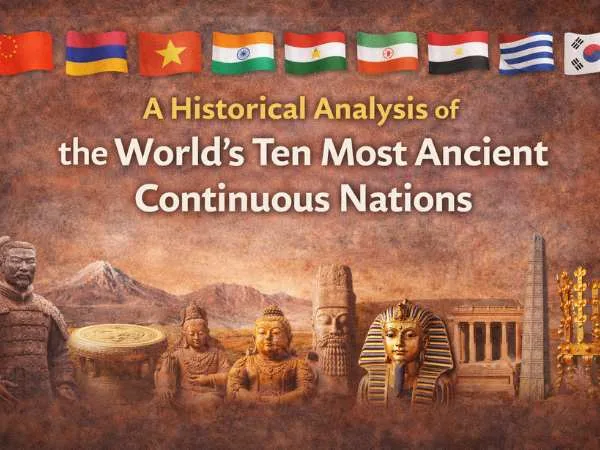

Determining the oldest countries in the world presents a complex historiographical challenge. Standard geographic representations and conventional educational curricula frequently emphasize modern geopolitical borders, thereby obscuring the profound chronological depth and cultural continuity characterizing certain regions. A rigorous examination of global history reveals several nations that have demonstrated extraordinary resilience, maintaining distinct cultural, linguistic, or political identities across millennia despite conflict, environmental shifts, and imperial conquests.
The Limitations of Conventional Historical Frameworks
Conventional pedagogical approaches frequently reduce historical instruction to the rote memorization of chronological events, often failing to convey the dynamic and enduring nature of ancient civilizations. Consequently, the perception of antiquity is frequently relegated to architectural ruins rather than recognized as the foundation of extant, continuously evolving cultures.
This cognitive disconnect diminishes the broader comprehension of global history. A superficial understanding of international relations frequently overlooks the deep historical contexts that inform contemporary geopolitical dynamics. Recognizing the longevity of these nations is essential for achieving a nuanced perspective on global historical trajectories.
Criteria for Determining Antiquity
Evaluating the antiquity of modern nations requires establishing specific parameters. For the purposes of this analysis, “ancient” is defined by the demonstrated continuity of a distinct cultural identity, linguistic tradition, or governance structure tied to a specific geographic region. The following assessment details ten nations characterized by their remarkable historical endurance, ranked chronologically by the approximate origins of their foundational civilizations.
10. San Marino (Founded c. 301 AD)

San Marino, a European microstate enclaved entirely within the Italian Peninsula, is widely recognized as the world’s oldest surviving constitutional republic. Historical consensus attributes its founding to Marinus of Rab, a Christian stonemason seeking refuge from religious persecution under the Roman Emperor Diocletian in 301 AD. San Marino’s ability to maintain its sovereign independence through the collapse of the Roman Empire, the fragmentation of medieval Italy, and two World Wars represents a remarkable feat of geopolitical endurance and diplomatic neutrality.
9. Japan (Traditional Founding c. 660 BC)

The island nation of Japan possesses a profoundly deep historical lineage, traditionally tracing its imperial establishment to 660 BC under Emperor Jimmu. Japan is distinguished by possessing the oldest continuous hereditary monarchy globally, with the same imperial lineage occupying the Chrysanthemum Throne for over two millennia. This cultural preservation was significantly facilitated by the nation’s geographic isolation, which served as a natural barrier against large-scale foreign invasions, allowing for the uninterrupted development of distinct sociological structures, martial traditions, and architectural methodologies.
also read : – Kharg Island: The Tiny Speck Holding Your Gas Prices Hostage
8. Ethiopia (Foundational Roots c. 980 BC)
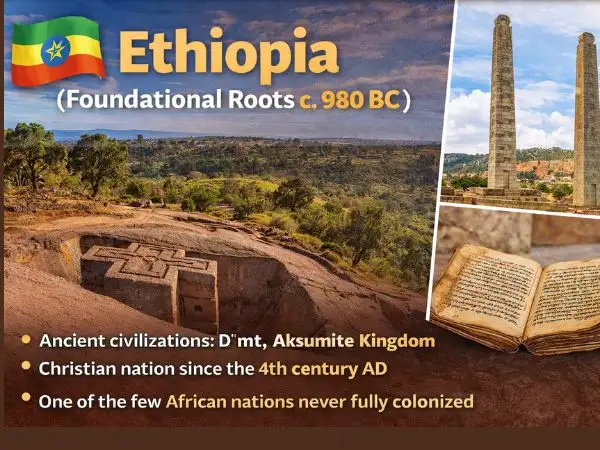
Ethiopia occupies a unique position in global history, notably distinguished as the only African nation to successfully resist systematic European colonization. Its historical continuum is frequently traced to the D’mt kingdom, which emerged approximately around 980 BC. The nation possesses a highly distinct cultural identity, characterized by an independent calendrical system, the unique Ge’ez script, and monumental architectural achievements, most notably the monolithic rock-hewn churches of Lalibela. This continuous cultural trajectory highlights a profound historical resilience.
7. Greece (Foundational Roots c. 1600 BC)

The modern Hellenic Republic is the cultural descendant of civilizations that fundamentally shaped Western philosophy, democratic governance, and mathematical theory. The origins of advanced civilization in this region are generally attributed to the Mycenaean culture, which flourished around 1600 BC. Despite centuries of warfare, imperial subjugation, and political reorganization, the fundamental tenets of Greek culture, language, and intellectual heritage have demonstrated extraordinary persistence over thousands of years.
6. China (Foundational Roots c. 2070 BC)

China represents one of the world’s most enduring and influential continuous civilizations. The establishment of the Xia Dynasty, estimated around 2070 BC, marks the beginning of its recorded dynastic history. The civilization is distinguished by substantial early technological innovations, including the invention of paper, gunpowder, and advanced metallurgical techniques. Furthermore, the remarkable continuity of the Chinese logographic writing system allows contemporary scholars to interpret texts composed millennia ago, illustrating an unprecedented degree of cultural transmission.
5. Armenia (Foundational Roots c. 2470 BC)
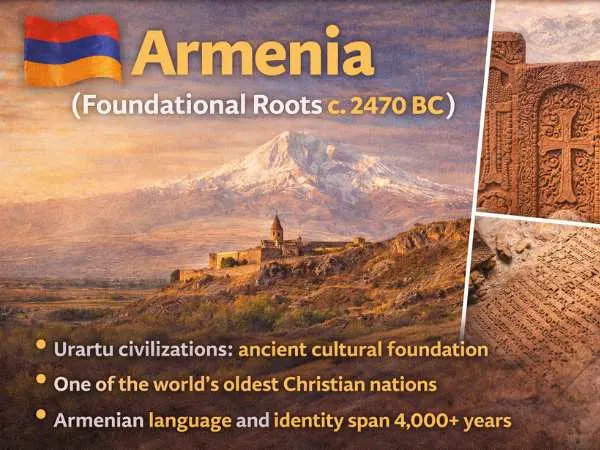
Situated at the strategic crossroads of Eastern Europe and Western Asia, Armenia possesses a historical lineage dating to the Early Bronze Age, approximately 2470 BC. The Armenian populace has exhibited significant resilience, maintaining cultural cohesion despite occupying a territory historically contested by major hegemonic powers, including the Roman, Persian, and Ottoman empires. Furthermore, Armenia holds the historical distinction of being the first nation to formally adopt Christianity as its state religion in 301 AD, a defining characteristic of its enduring national identity.
4. Vietnam (Foundational Roots c. 2879 BC)
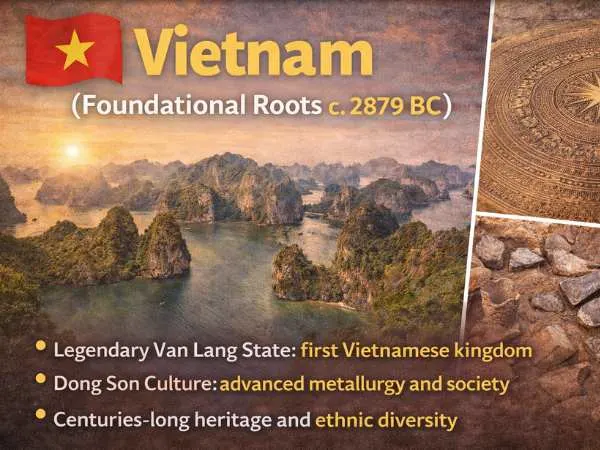
The historical narrative of Vietnam is characterized by a persistent and successful defense of territorial and cultural integrity. Traditional historiography traces the nation’s origins to the Hong Bang dynasty, established circa 2879 BC. The subsequent millennia involved extensive periods of conflict and resistance against larger neighboring empires attempting to exert regional hegemony. The endurance of the Vietnamese identity, deeply rooted in familial structures and agricultural traditions, demonstrates significant cultural fortitude.
3. India (Foundational Roots c. 3300 BC)
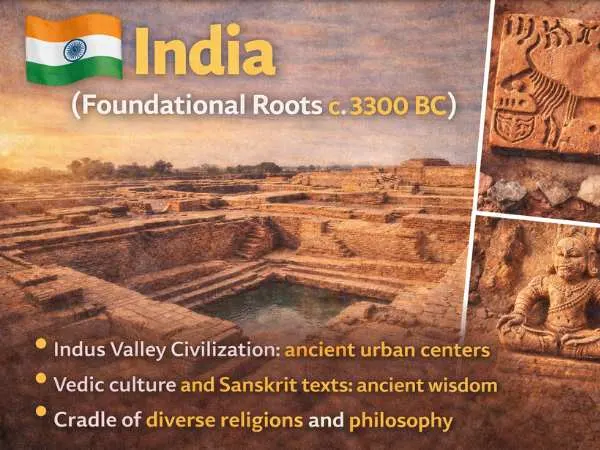
The Indian subcontinent is the locus of one of humanity’s earliest urban societies, the Indus Valley Civilization, which emerged circa 3300 BC. This early culture was characterized by advanced urban planning and complex municipal infrastructure. India is also the birthplace of Hinduism, one of the world’s oldest continuously practiced major religions. Despite a history punctuated by numerous foreign incursions and imperial administrations, the core cultural and religious frameworks of the subcontinent have consistently demonstrated a capacity for assimilating external influences while preserving fundamental traditions.
2. Iran (Foundational Roots c. 3200 BC)

Historically identified as Persia, modern Iran possesses a historical trajectory foundational to the development of early global empires. The region’s organized civilization originated with the Elamite kingdom around 3200 BC, eventually culminating in the expansive Achaemenid Empire. The Persian administrative structures, including advanced communication networks and monumental architecture, heavily influenced subsequent global governance models. Despite experiencing profound religious and political transformations over the centuries, the Persian linguistic, artistic, and cultural heritage remains remarkably intact.
1. Egypt (Foundational Roots c. 3100 BC)

The Arab Republic of Egypt is generally recognized as possessing the deepest foundational roots of any extant nation. The formal unification of Upper and Lower Egypt under King Narmer circa 3100 BC marked the genesis of a civilization that would produce unprecedented architectural, linguistic, and scientific advancements. Situated along the Nile River, ancient Egypt developed the hieroglyphic script and constructed monumental edifices that remain standing today. The longevity and profound global influence of this early civilization secure its position as the preeminent ancient nation.
The Sociological Significance of Historical Continuity
The academic study of these enduring nations provides critical insights into human resilience and societal sustainability. These nations have successfully navigated catastrophic events, including pandemic diseases, systemic warfare, and environmental crises. An analysis of their historical trajectories offers valuable perspectives on the mechanisms by which cultures adapt, endure, and preserve collective identities across extended chronological periods.
Frequently Asked Questions (FAQ)
What defines a country as “ancient” in a modern context?
In historiographical terms, an “ancient” country is one that demonstrates a demonstrable continuity of cultural identity, linguistic heritage, or institutional governance stretching back several millennia within a relatively consistent geographic locus.
How does the antiquity of modern Iraq compare to that of Iran?
While the geographic territory of modern Iraq encompasses ancient Mesopotamia—frequently termed the “cradle of civilization”—the modern nation-state of Iraq has not maintained the same continuous, unbroken cultural and linguistic trajectory that characterizes the transition from ancient Persia to modern Iran.
Why are civilizations such as the Maya or Aztecs excluded from this classification?
While the Mesoamerican civilizations achieved remarkable societal complexity, their centralized empires experienced systemic collapse. Consequently, they do not exist today as sovereign, continuous nation-states, thereby precluding their inclusion in an analysis of extant ancient countries.
Have the territorial borders of these nations remained static?
No. The sovereign borders of virtually all nations analyzed have fluctuated significantly due to conflict, treaties, and imperial expansion. The continuity refers to the cultural and demographic core rather than strict adherence to ancient cartographic boundaries.
Conclusion
History is not a static academic discipline but a dynamic continuum that directly informs contemporary global structures. Recognizing the profound chronological depth of nations such as Egypt, Iran, and India is essential for fostering a comprehensive understanding of human civilization. The capacity of these cultures to endure and evolve over thousands of years stands as a testament to the resilience of human societies.