


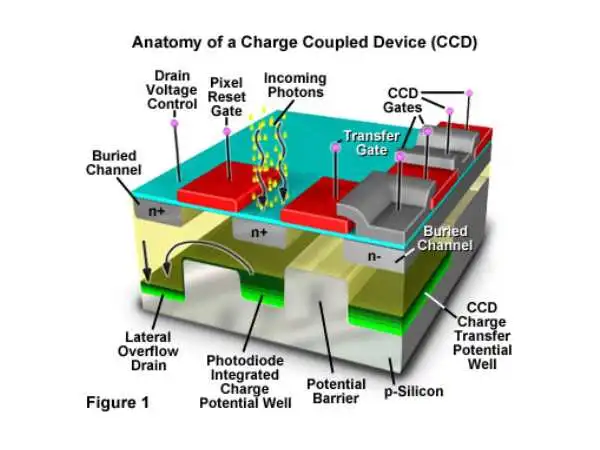

The charge coupled device, usually called a CCD, sits behind some of the most important imaging systems ever built. Long before smartphone cameras became powerful, CCD sensors captured images of distant galaxies, medical scans, scientific experiments, and broadcast-quality video. Even today, CCDs remain relevant where image quality matters more than cost or power savings.
This blog explains the charge coupled device (CCD) in depth. You’ll learn how a CCD works, its working principle, CCD formats, noise sources, CCD detectors, CCD memory concepts, and how CCDs are used in radiology and scientific imaging. The goal is clarity, not shortcuts.
What Is a Charge Coupled Device (CCD)
A charge coupled device (CCD) is an electronic image sensor that converts light into electrical charge and then transfers that charge across the chip for measurement.
Each CCD consists of an array of tiny light-sensitive elements called pixels. When light hits these pixels, it creates an electric charge proportional to the light intensity. That charge is then moved, step by step, across the device to an output node where it is measured and converted into a digital signal.
The key idea is simple:
light in → charge stored → charge shifted → signal read out
also read : – Candy AI: The Best Platform For Having an AI Boyfriend and Girlfriend
Why CCD Technology Was a Breakthrough
Before CCDs, electronic imaging was noisy and inconsistent. CCDs introduced a way to move charge across a chip with very low loss. This allowed:
- high image uniformity
- excellent sensitivity
- low fixed pattern noise
- reliable measurement of faint signals
This made CCDs ideal for astronomy, medical imaging, and scientific instruments.
Charge Coupled Device Working Principle
The charge coupled device working principle revolves around controlled charge movement using electric fields.
Each pixel acts like a tiny bucket that collects charge when light hits it. After exposure, clock signals shift these charge packets from one pixel to the next until they reach the output amplifier.
This transfer happens in a synchronized way, ensuring the original image pattern stays intact.
Step-by-Step CCD Working Process
Step 1: Photon Absorption
Light enters the CCD and strikes the silicon substrate. Photons free electrons through the photoelectric effect.
Step 2: Charge Accumulation
Each pixel stores the generated electrons in a potential well. Brighter areas create more charge.
Step 3: Charge Transfer
Clock voltages move the stored charge from pixel to pixel, row by row or column by column.
Step 4: Charge Measurement
The charge reaches the output node, where it is converted into a voltage signal.
Step 5: Analog-to-Digital Conversion
The voltage signal is digitized, forming the final image.
This precise transfer mechanism defines CCD performance.
also read : – What Does ICL Mean on Snapchat, WhatsApp, TikTok?
Charge Coupled Device Working vs CMOS Sensors
CCD and CMOS sensors both capture images, but they operate differently.
CCD sensors:
- transfer charge across the chip
- use a single or few amplifiers
- produce uniform output
- consume more power
CMOS sensors:
- convert charge at each pixel
- allow faster readout
- use less power
- vary more between pixels
CCDs still excel in low-noise and scientific imaging.
CCD Formats Explained
CCD formats describe the physical size and shape of the sensor.
Common formats include:
- Full-frame CCD
- Frame-transfer CCD
- Interline-transfer CCD
Each format balances sensitivity, speed, and complexity.
Full-Frame CCD Format
In a full-frame CCD, the entire sensor area collects light. After exposure, the image is transferred for readout.
Advantages:
- high sensitivity
- large active area
Limitations:
- requires a shutter
- slower readout
Used widely in astronomy and research.
also read : – Benefits of Shower Panel System
Frame-Transfer CCD Format
Frame-transfer CCDs divide the sensor into two areas:
- image area
- storage area
After exposure, charge moves quickly to the storage area, allowing fast readout without a shutter.
This design suits scientific cameras needing precise timing.
Interline -Transfer CCD Format
Interline CCDs place storage registers next to each pixel column.
Advantages:
- fast readout
- electronic shuttering
Limitations:
- reduced light-sensitive area
Common in video cameras and industrial imaging.
Charge Coupled Device Detector
A charge coupled device detector refers to a CCD used specifically for detecting radiation, light, or particles in measurement systems.
CCD detectors appear in:
- astronomy telescopes
- spectroscopy systems
- X-ray detectors
- medical imaging devices
They are valued for sensitivity and accuracy.
also read : – Which NIMS Structure Makes Cooperative Multi- Agency Decisions?
CCD Detector Sensitivity
CCD detectors can measure very faint signals. Cooling the sensor reduces thermal noise, allowing detection of weak light sources such as distant stars.
This sensitivity makes CCDs central to scientific discovery.
CCD Camera Noise Sources
No sensor is perfect. CCD camera noise sources affect image quality and must be managed carefully.
Shot Noise
Shot noise arises from the statistical nature of photon arrival. It increases with signal strength and cannot be eliminated completely.
Dark Current Noise
Dark current noise comes from thermal electrons generated even without light. Cooling the CCD reduces this noise significantly.
Readout Noise
Readout noise occurs during charge conversion and amplification. CCDs are known for low readout noise compared to many CMOS sensors.
Fixed Pattern Noise
Fixed pattern noise appears as consistent pixel-to-pixel variation. CCDs generally show less fixed pattern noise than CMOS devices.
Managing Noise in CCD Systems
Noise control strategies include:
- cooling the sensor
- slow readout speeds
- calibration frames
- shielding from interference
These steps improve signal clarity.
also read : – Which NIMS Structure Makes Cooperative Multi- Agency Decisions?
Charge Coupled Device Memory Concept
The idea of charge coupled device memory came from the same charge-shifting principle.
Early researchers explored CCDs as analog memory devices, storing charge packets and shifting them over time.
Although CCD memory never replaced semiconductor RAM, the concept influenced signal processing and delay lines.
CCDs in Digital Imaging Systems
In imaging systems, CCDs act as the front-end sensor. The quality of the final image depends heavily on how accurately the CCD captures and transfers charge.
High-end imaging still relies on CCDs when image fidelity matters most.
Charge Coupled Device in Radiology
The charge coupled device in radiology plays a role in digital imaging systems such as:
- digital X-ray
- fluoroscopy
- mammography
- dental imaging
In these systems, CCDs convert light from scintillators into electrical signals.
Why CCDs Are Used in Radiology
Radiology demands:
- high contrast
- low noise
- precise detail
CCDs deliver consistent output and reliable grayscale accuracy, which is critical for diagnosis.
CCD vs Flat-Panel Detectors in Radiology
While flat-panel detectors dominate modern systems, CCD-based systems remain in use for specialized imaging due to:
- cost efficiency
- proven reliability
- excellent image uniformity
CCD in Astronomy
Astronomy remains one of the strongest domains for CCD technology.
CCD detectors:
- capture faint stars
- support long exposures
- maintain linear response
Many major discoveries relied on CCD imaging.
CCD in Scientific Research
Laboratories use CCDs in:
- spectroscopy
- microscopy
- particle detection
- fluorescence imaging
The predictable behavior of CCDs supports accurate measurement.
CCD in Industrial Imaging
Industrial systems use CCDs for:
- inspection
- measurement
- machine vision
Uniform response and low noise improve defect detection.
Advantages of Charge Coupled Devices
CCD advantages include:
- high image quality
- low noise
- excellent uniformity
- stable performance
These strengths explain their continued use.
Limitations of CCD Technology
CCDs also face challenges:
- higher power consumption
- slower readout
- complex manufacturing
- higher cost
These factors opened the door for CMOS dominance in consumer devices.
Why CCDs Still Matter
Despite CMOS popularity, CCDs remain relevant where:
- signal accuracy matters
- lighting is low
- noise must be minimal
Many scientific instruments still depend on CCDs.
Future of CCD Technology
CCD development continues in niche areas. Improvements focus on:
- better cooling
- improved quantum efficiency
- specialized detectors
CCDs are unlikely to disappear entirely.
CCD vs CMOS: The Bigger Picture
CMOS won consumer markets. CCDs kept scientific ground.
Both technologies coexist, serving different priorities.
Choosing Between CCD and CMOS
Selection depends on:
- application
- budget
- power constraints
- image requirements
There is no universal winner.
Real-World CCD Performance Factors
CCD performance depends on:
- sensor design
- readout electronics
- cooling method
- calibration quality
System design matters as much as the sensor itself.
Final Thoughts on Charge Coupled Device
The charge coupled device changed imaging forever. Its elegant working principle, precise charge transfer, and low noise output set a benchmark that shaped modern sensors. Even as CMOS dominates everyday devices, CCDs remain essential in science, medicine, and research where quality comes first.
Understanding CCDs means understanding how light becomes data—accurately, consistently, and reliably.
FAQs: Charge Coupled Device (CCD)
What is a charge coupled device
An image sensor that converts light into charge and transfers it for measurement.
What is the charge coupled device working principle
Light creates charge in pixels, which is shifted across the chip and read out.
What are CCD formats
Full-frame, frame-transfer, and interline-transfer CCDs.
What are CCD camera noise sources
Shot noise, dark current, readout noise, and fixed pattern noise.
Where are CCDs used
Astronomy, radiology, scientific research, and industrial imaging.