


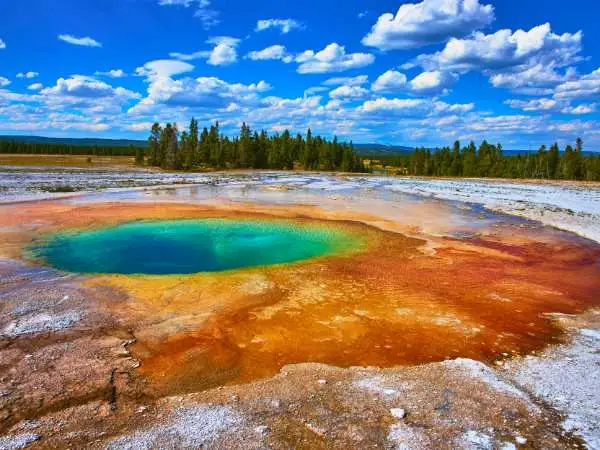

When people search yellowstone volcano, fear usually sits right behind curiosity. Headlines scream about super-eruptions. Social media predicts dates. Videos claim the ground is swelling and the end is near. I’ve watched this cycle repeat for years. Panic rises. Scientists respond. Panic fades. Then it starts again.
The truth is calmer, stranger, and far more interesting. Yellowstone is not a classic volcano. It has no cone. No towering peak. No smoking crater. And yet, it holds one of the largest volcanic systems on Earth. Understanding it means letting go of movie-style volcano ideas and learning how this place actually works.
This blog explains the Yellowstone Volcano name, why it looks flat, how deep it really is, what the last eruption tells us, eruption history, height myths, and why predicted eruption dates keep circulating even though none exist.
What Is the Yellowstone Volcano
The Yellowstone Volcano sits beneath Yellowstone National Park in the United States. It spans parts of Wyoming, Montana, and Idaho. Unlike Mount Etna or Mount Fuji, Yellowstone does not rise above the land as a cone. It spreads under it.
This volcanic system formed over a hotspot in Earth’s mantle. As the North American tectonic plate moved over that hotspot, massive eruptions reshaped the land again and again.
What we see today is not a mountain. It’s a collapsed volcanic basin.
also read : – How to Stick a Tampon In: A Calm, Real-Life Guide for First-Timers and Beginners
Yellowstone Volcano Name: What Do Scientists Call It
Many people ask about the Yellowstone Volcano name, expecting something dramatic. There is no single formal volcano name like “Mount Something.”
Scientists refer to it as:
- The Yellowstone volcanic system
- The Yellowstone caldera
- The Yellowstone hotspot
The word “supervolcano” describes eruption potential, not structure. It’s a category, not a name.
Why Is Yellowstone Volcano Flat
This question trips up many people. Why is Yellowstone volcano flat when volcanoes usually form mountains?
The answer lies in scale.
Yellowstone’s largest eruptions were so powerful that they emptied enormous magma chambers. When that happened, the ground above collapsed inward instead of building upward. That collapse formed a caldera roughly 30 by 45 miles wide.
Think sinkhole, not peak.
Over time, lava flows, sediment, and vegetation filled parts of the caldera. The result looks like rolling highland, not a volcano.
also read : – Reliant Energy Plans, How They Work, and How People Choose the Right Option
Yellowstone Volcano Height: A Misleading Idea
People often search Yellowstone volcano height, expecting a number like Mount Everest or Mount Rainier.
Yellowstone has no volcanic “height” in the usual sense. The land sits at high elevation, but that elevation comes from the Rocky Mountains, not a volcanic cone.
Average elevation in the park sits around 8,000 feet above sea level. That does not reflect volcanic buildup. It reflects regional uplift.
Yellowstone is wide, not tall.
How Deep Is Yellowstone Volcano
The question how deep is Yellowstone volcano leads us underground.
Below the surface, Yellowstone holds:
- A shallow magma reservoir about 3 to 10 miles deep
- A deeper magma system extending down over 40 miles
These are not giant underground lakes of molten rock. Most of the material remains solid or semi-molten. Only a fraction stays liquid.
This matters, since eruption potential depends on melt percentage, not size alone.
Yellowstone Volcano Last Eruption
The Yellowstone Volcano last eruption occurred around 70,000 years ago. That event was small compared to earlier super-eruptions.
It involved:
- Lava flows
- Limited ash
- No global impact
The last super-eruption happened much earlier, about 640,000 years ago.
Since then, Yellowstone has remained volcanically active in quieter ways.
Yellowstone Volcano Eruption History
Yellowstone’s eruption history includes three massive super-eruptions.
First Super-Eruption
About 2.1 million years ago
Created the Huckleberry Ridge Tuff
One of the largest eruptions in Earth’s history
Second Super-Eruption
About 1.3 million years ago
Smaller but still enormous
Third Super-Eruption
About 640,000 years ago
Formed the current Yellowstone caldera
Each eruption reshaped continents with ash fall.
also read : – Alpha Wolves: Myth, Meaning, and the Truth Behind the Theory
Yellowstone Volcano Eruption Date: Why None Exists
Searches for Yellowstone Volcano eruption date spike during earthquakes or viral videos.
Here’s the reality.
There is no predicted eruption date.
Volcanoes do not work on schedules. Scientists monitor trends, not clocks. Earthquake swarms, ground uplift, and gas emissions all fluctuate naturally at Yellowstone.
None currently signal an imminent eruption.
What Makes Yellowstone a Supervolcano
Yellowstone qualifies as a supervolcano due to eruption volume potential.
A super-eruption ejects:
- Over 1,000 cubic kilometers of material
Yellowstone meets that threshold based on past events.
That does not mean it erupts often. In fact, super-eruptions remain extremely rare.
What Happens Underground Right Now
Yellowstone stays active every day.
Signs include:
- Earthquake swarms
- Ground rising and falling
- Geysers erupting
- Hot springs shifting
This activity shows heat movement, not eruption preparation.
Yellowstone behaves like a giant pressure-release system.
Why Earthquakes Happen So Often at Yellowstone
Yellowstone experiences thousands of small earthquakes each year.
Most measure below magnitude 3.
These quakes happen as:
- Rock fractures adjust
- Fluids move underground
- Heat shifts crust layers
They are normal for geothermal regions.
also read : – Top Ten Inventions in India: Know The Best Inventions of India Here
Yellowstone Geysers: The Surface Clues
Geysers exist because heat and water interact underground.
Yellowstone hosts over half of the world’s geysers.
Famous examples include:
- Old Faithful
- Steamboat Geyser
- Castle Geyser
These features rely on heat, not magma rising.
Can Yellowstone Erupt Again
Yes. Eventually.
Will it erupt soon? No evidence supports that.
Smaller lava eruptions remain more likely than a super-eruption. Those would affect the park, not the planet.
What a Yellowstone Super-Eruption Would Do
A full super-eruption would:
- Cover large parts of the U.S. in ash
- Disrupt agriculture
- Affect global climate
This scenario sits in the realm of geological time, not daily risk.
How Scientists Monitor Yellowstone Volcano
Monitoring systems include:
- GPS stations
- Seismographs
- Gas sensors
- Satellite imaging
Data updates constantly. Alerts rise only if patterns change sharply.
Why Yellowstone Isn’t the Most Dangerous Volcano
Other volcanoes pose greater near-term risk.
Examples include:
- Vesuvius
- Merapi
- Taal
Those volcanoes erupt often and sit near dense populations.
Yellowstone erupts rarely.
Yellowstone vs Other Supervolcanoes
Yellowstone is not alone.
Other supervolcano systems include:
- Toba in Indonesia
- Taupo in New Zealand
All share long dormancy periods.
also read : – The Digital Portfolio Trap: How Over-Designing Your Online Presence Could Be Holding You Back
Why Yellowstone Myths Spread So Easily
Fear sells. Simplicity spreads. Complex geology doesn’t.
Online content often:
- Exaggerates data
- Ignores probability
- Confuses activity with danger
That fuels panic cycles.
Yellowstone Volcano and Climate Change
Climate change does not cause eruptions.
Melting ice may slightly alter surface pressure, but evidence does not support eruption triggering.
Volcanic systems operate far deeper.
How Yellowstone Affects Wildlife
Animals sense heat, not future eruptions.
Bison movement patterns reflect:
- Seasonal changes
- Food availability
- Human presence
They do not predict volcanic events.
Can Humans Stop Yellowstone
No.
Humans can monitor, plan, and respond. They cannot shut down a supervolcano.
Preparedness matters more than fear.
Yellowstone Volcano in Popular Culture
Movies and documentaries often exaggerate.
They compress timelines and boost drama.
Real geology works slowly.
Why Yellowstone Still Matters
Yellowstone teaches scientists about:
- Hotspot volcanism
- Crust movement
- Geothermal systems
It acts as a natural laboratory.
FAQs
What is the Yellowstone Volcano name
It is called the Yellowstone volcanic system or Yellowstone caldera.
Why is Yellowstone volcano flat
It collapsed inward after massive eruptions rather than building upward.
When was the Yellowstone Volcano last eruption
The last eruption occurred about 70,000 years ago.
How deep is Yellowstone volcano
Magma reservoirs sit several miles beneath the surface, with deeper systems extending much farther.
Is there a Yellowstone Volcano eruption date
No. Scientists do not predict eruption dates.
Final Words
The yellowstone volcano is powerful, real, and misunderstood. It doesn’t loom above the land. It rests beneath it. Quiet most days. Active in subtle ways. Dangerous in theory, calm in reality. Fear fades when facts step in. Yellowstone reminds us that Earth moves on scales far larger than panic cycles, and far slower than headlines suggest.